
Understanding Medicare Part D Prescription Drug Coverage Changes for 2020

Web Exclusives - Ovarian Cancer

Medicare prescription drug coverage is an optional benefit offered to everyone who has Medicare. There are 2 ways for eligible patients to enroll—through Medicare Advantage or through Medicare Part D. Medicare Advantage plans (also known as Part C) offer Medicare prescription drug coverage along with medical coverage and other benefits. Since 2006, Medicare beneficiaries have had access to prescription drug coverage through Part D, where private plan sponsors contract with Medicare to provide drug benefits only. Part D benefits can be purchased in addition to Original (or fee-for-service) Medicare and supplemental, or Medigap coverage, neither of which covers prescription drugs. Medicare Part D plans cover brand-name and generic prescription drugs.

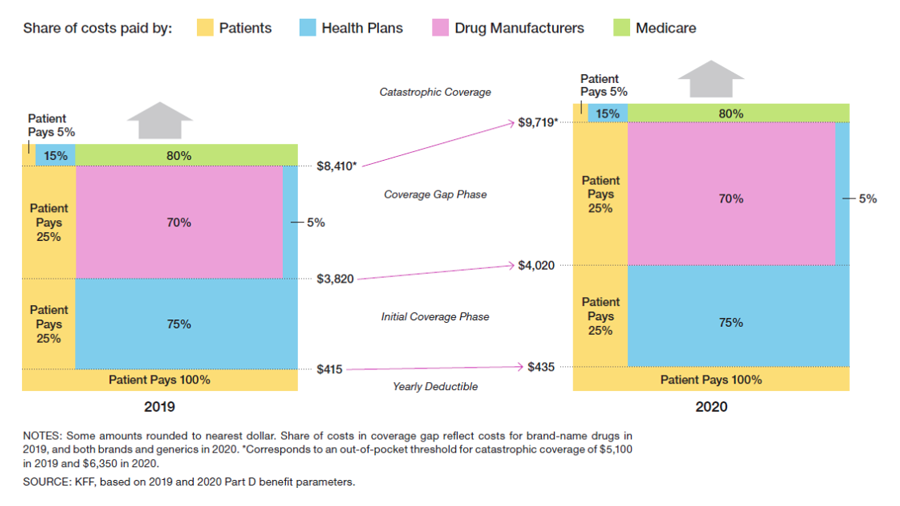
The standard Medicare Part D benefit has changed for 2020, as shown below.
Figure

The Medicare Part D yearly deductible increases to $435 in 2020, up from $415 in 2019. Patients must pay 100% of the cost of their prescription drugs until the cap of $435 is reached. After the yearly deductible is met, patients move through the initial coverage phase and are responsible for 25% of brand-name drug costs until a total of $4020 is spent. Subsequently, they move through the coverage gap phase (formerly the donut hole, which no longer exists) until a total of $9719 is spent. During the initial coverage and coverage gap phases, the remaining 75% is paid by health insurers and drug companies. The cap was increased substantially between 2019 and 2020, from $8410 to $9719. As a result, many Medicare Part D enrollees will face a substantial increase in out-of-pocket drug costs before they qualify for catastrophic coverage in 2020.

After reaching the catastrophic phase of coverage, beneficiaries are responsible for 5% of the cost of prescription drugs for the remainder of the calendar year. However, many Medicare Part D plans have no out-of-pocket spending cap. Even with 5% cost-sharing, this can have important financial implications for some patients throughout the calendar year.

Related Items
Duration of PARP Inhibitor Maintenance Therapy in Patients With Ovarian Cancer With Germline or Somatic BRCA Mutations
JHOP - February 2024 Vol 14, No 1 published on February 22, 2024 in Original Research, PARP Inhibitors, Ovarian Cancer, Screening
Duration of Response to PARP Inhibitors for Maintenance Treatment of Ovarian Cancer in Patients With Germline or Somatic HRD
JHOP - August 2023 Vol 13, No 4 published on August 17, 2023 in Original Research, PARP Inhibitors, Ovarian Cancer, Screening
Successful Extended At-Home Olaparib Desensitization After a Hypersensitivity Reaction: A Case Report
JHOP - June 2023 Vol 13, No 3 published on June 21, 2023 in Case Reports, PARP Inhibitors, Adverse Events, Oral Therapy, Ovarian Cancer
How to Sequence Treatment in Relapsed Ovarian Cancer
2021 Year in Review - Ovarian Cancer published on January 18, 2022 in Ovarian Cancer
Maintenance Gemogenovatucel-T Immunotherapy in Newly Diagnosed Advanced Ovarian Cancer
2021 Year in Review - Ovarian Cancer published on January 18, 2022 in Ovarian Cancer
Patient Self-Reporting of Tolerability in Phase 2 Trial Comparing Gemcitabine plus Adavosertib or Placebo in Women with Platinum-Resistant Epithelial Ovarian Cancer
2021 Year in Review - Ovarian Cancer published on January 18, 2022 in Ovarian Cancer
Mirvetuximab Soravtansine plus Bevacizumab in Patients with Recurrent Ovarian Cancer
2021 Year in Review - Ovarian Cancer published on January 18, 2022 in Ovarian Cancer
NeoPembrOV Study of Neoadjuvant Chemotherapy with or without Pembrolizumab Followed by Interval Debulking Surgery and Standard Systemic Therapy with or without Pembrolizumab for Advanced High-Grade Serous Carcinoma
2021 Year in Review - Ovarian Cancer published on January 18, 2022 in Ovarian Cancer
Optimal Treatment Duration of Bevacizumab plus Carboplatin/Paclitaxel in Advanced Ovarian Cancer
2021 Year in Review - Ovarian Cancer published on January 18, 2022 in Ovarian Cancer
Phase 1 Study of GAS6/AXL Inhibitor (AVB-500) in Recurrent, Platinum-Resistant Ovarian Carcinoma
2021 Year in Review - Ovarian Cancer published on January 18, 2022 in Ovarian Cancer